
 Pakistan
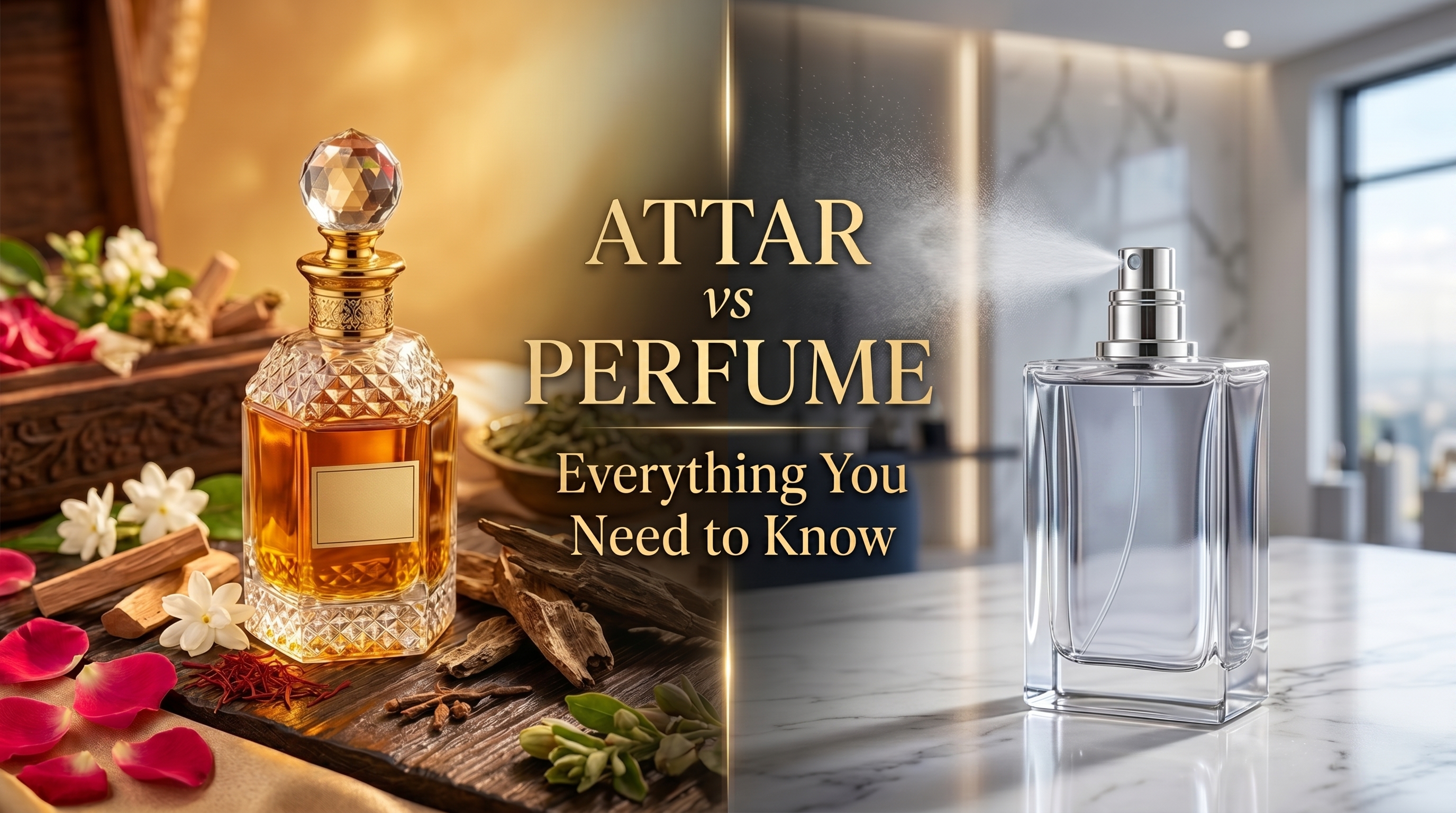
Walking into Misky store, you will find two very different worlds side by side - traditional attar oils and modern spray perfumes. Both promise a beautiful scent, but they are not the same experience at all.
Most people use the terms interchangeably, but attar and perfume are fundamentally different in how they are made, how they are used, how long they last, and even what they represent culturally and spiritually.
In this complete guide, we break down every key difference between attar and perfume so you can make the right choice for your lifestyle, skin type, and values.
What Is Attar?
Attar - also spelt Ittar - is a natural fragrance oil extracted from botanical sources such as flowers, herbs, spices, and woods through a traditional distillation process.
The word ‘Attar’ comes from the Persian and Arabic word for perfume, reflecting its deep Middle Eastern and South Asian roots. Attar has been used for thousands of years across India, Pakistan, the Middle East, and beyond - long before modern perfumery even existed.
Key Characteristics of Attar
- 100% Alcohol-Free - No ethanol or synthetic solvents
- All-Natural Ingredients - Rose, jasmine, oud, sandalwood, saffron, musk
- Highly Concentrated - A single small drop lasts all day
- Handcrafted - Made using the ancient Deg Bhapka distillation method
- Skin-Safe - Oil-based and gentle even on sensitive skin
- Islamic Tradition - Using fragrance is a Sunnah; attar is fully Halal
How Is Attar Made?
Traditional attar production is a slow, artisanal process. Botanical materials - flowers, spices, or woods - are placed in a large copper vessel (called a Deg) with water and slowly heated. The fragrant steam travels through a pipe into a second vessel (called Bhapka) filled with sandalwood oil. The steam condenses into the oil, capturing the pure aroma of the botanical source.
No chemicals, no alcohol, no shortcuts, just nature.
The most famous attar production region in the world is Kannauj, India - often called the Perfume Capital of India - where this tradition has been preserved for over 400 years.
What Is Perfume?
Perfume is a modern fragrance product made by blending natural essential oils, synthetic aroma compounds, and a solvent - typically ethyl alcohol - together in precise ratios.
Perfumery as we know it today evolved in France in the 17th and 18th centuries. Today, it is a massive global industry with thousands of brands, scent profiles, and concentration levels.
Key Characteristics of Perfume
- Alcohol-Based - Ethanol makes up 70-90% of most perfumes
- Natural + Synthetic Blend - Combines real botanical extracts with lab-created molecules
- Spray Application - Quick, convenient, wide coverage
- Multiple Concentration Levels - Different strengths available
- Mass Produced - Available globally at various price points
- Wide Variety - Thousands of modern scent profiles
Perfume Concentration Types
|
Type |
Fragrance % |
Longevity |
|
Parfum / Extrait |
20-30% |
6-8 hours |
|
Eau de Parfum (EDP) |
15-20% |
4-6 hours |
|
Eau de Toilette (EDT) |
5-15% |
2-4 hours |
|
Eau de Cologne (EDC) |
2-4% |
1-2 hours |
|
Eau Fraiche |
1-3% |
1 hour |
Attar vs Perfume: Complete Comparison Table
|
Factor |
Attar (Ittar) |
Perfume |
|
Base |
Natural carrier oil |
Alcohol + water |
|
Ingredients |
100% natural botanicals |
Natural + synthetic |
|
Alcohol Content |
None |
70-90% |
|
Concentration |
Extremely high |
Medium to high |
|
Longevity |
8-24+ hours |
2-8 hours |
|
Application |
Dab on pulse points |
Spray |
|
Skin Safety |
Safe for sensitive skin |
Can irritate sensitive skin |
|
Price |
Higher (pure, handcrafted) |
Wide range |
|
Eco-Friendly |
Yes |
Less so |
|
Halal Status |
Fully Halal |
Debated amongst scholars |
|
Cultural Roots |
Middle East, South Asia |
Western (France, Europe) |
7 Key Differences Between Attar and Perfume
1. Ingredients - What Goes Into Each?
This is the most fundamental difference.
Attar is made exclusively from natural botanical sources. Every drop comes from real flowers, roots, woods, or spices. There are no synthetic molecules, no lab chemicals, and no artificial preservatives involved.
Perfume blends natural essential oils with synthetic aroma compounds. These synthetics allow perfumers to create consistent scents at scale, replicate rare or endangered botanical notes, and keep costs manageable. Many iconic perfumes contain only a small percentage of natural ingredients.
Winner for purity: Attar
2. Longevity - Which One Lasts Longer?
This is the difference most people notice immediately.
Attar is oil-based. When you apply it to your pulse points - wrists, neck, behind the ears - it blends with your natural skin oils and releases its fragrance slowly throughout the day. A single drop of quality attar can last 8 to 24 hours or longer.
Perfume contains alcohol, which evaporates quickly after application and carries the fragrance with it. The scent fades faster, especially in hot weather. Most perfumes require reapplication every few hours.
Quick Fact: One tiny bottle of best-quality attar in Pakistan can outlast an entire bottle of spray perfume in terms of total uses.
Winner for longevity: Attar
3. Skin Safety - Which Is Better for Sensitive Skin?
Attar is oil-based and alcohol-free, making it naturally gentle. It does not dry out the skin, does not cause redness, and is generally well-tolerated even by people with eczema or fragrance sensitivities. In fact, many natural attars (like sandalwood and rose) have mild skin-soothing properties.
Perfume contains ethyl alcohol, which can be drying and irritating - especially when applied directly to sensitive or dry skin. The synthetic compounds in some perfumes can also trigger allergic reactions in sensitive individuals.
Winner for sensitive skin: Attar
4. Islamic Perspective - What Does Islam Say?
Attar is not just permissible - it is a Sunnah. The Holy Prophet Sayyiduna Muhammad صلی اللہ علیہ واٰلہ وسلم loved fragrance and encouraged its use. Since attar is completely alcohol-free and derived from natural sources, it is universally accepted as Halal by all Islamic scholars.
Perfume is a matter of scholarly discussion. Many contemporary scholars hold that alcohol-based perfume is permissible for external use since it is not consumed. However, for those who prefer to err on the side of caution, attar is the clear and universally accepted choice.
Winner for Islamic use: Attar
5. Application Method - How Do You Wear Each?
Attar is applied by dabbing a small amount directly onto the skin using the applicator rod or fingertip. The best spots are pulse points - wrists, neck, behind the ears, and the inner elbows - where body heat naturally diffuses the fragrance.
Tip: Do not rub your wrists together after applying attar. This breaks down the fragrance molecules and shortens their life.
Perfume is sprayed from a distance of about 15-20 cm. It can be applied to skin, clothing, or hair. The spray covers a wider area and creates an initial burst of scent (known as projection).
6. Price - Which Is More Expensive?
Attar tends to be more expensive per millilitre - and for good reason:
- Thousands of flowers are needed to produce just a few grams of attar
- The distillation process is slow and labour-intensive
- Pure natural ingredients have a limited global supply
For example, producing just one kilogram of rose attar requires several hundred thousand rose petals.
Perfume offers a much wider price range - from affordable drugstore options to luxury designer bottles - because synthetic ingredients reduce production costs significantly.
More accessible price-wise: Perfume
7. Environmental Impact - Which Is Greener?
Attar is produced through a natural distillation process using botanical materials and carrier oils. It is biodegradable, free of synthetic chemicals, and has minimal packaging waste in traditional forms.
Perfume involves synthetic chemical production, industrial manufacturing processes, and often excessive plastic and glass packaging. The alcohol base also requires large-scale fermentation and processing.
Eco-friendlier choice: Attar
Benefits of Attar
- Completely alcohol-free and Halal
- Extraordinary longevity - lasts all day
- Safe for sensitive and dry skin
- Aromatherapy benefits (oud, rose, sandalwood, jasmine)
- Eco-friendly and sustainable production
- A little goes a very long way
- Deep cultural and spiritual significance
- No synthetic chemicals or allergens
Benefits of Perfume
- Quick and convenient spray application
- Enormous variety of modern scent profiles
- Strong initial projection - people notice it immediately
- Widely available at all price points
- Great for gifting due to beautiful packaging
- Layering with body lotion extends wear time
Popular Types of Attar
|
Attar Type |
Scent Profile |
Best For |
|
Oud (Agarwood) |
Deep, woody, smoky |
Men’s luxury wear |
|
Rose (Gulab) |
Sweet, floral, romantic |
Women’s daily wear |
|
Jasmine (Chameli) |
Light, floral, fresh |
Women, summer |
|
Musk |
Warm, sensual, earthy |
Men and women |
|
Saffron (Kesar) |
Warm, spiced, royal |
Special occasions |
|
Sandalwood (Chandan) |
Earthy, creamy, grounding |
Meditation, unisex |
|
Amber |
Sweet, warm, resinous |
Evening wear, unisex |
How to Apply Attar Correctly
Getting the most out of your attar is simple once you know the right technique:
- Choose pulse points - wrists, neck, behind ears, inner elbows, back of knees
- Use 1-2 drops only - attar is highly concentrated, less is more
- Dab, do not rub - rubbing breaks fragrance molecules and shortens longevity
- Apply to clean skin - right after a shower gives the best results
- Avoid clothing - oil-based attar can leave stains on fabric
- Store properly - keep the bottle tightly sealed away from heat and sunlight
Attar vs Perfume - Which One Should You Choose?
|
If You Want... |
Choose |
|
Alcohol-free, Halal fragrance |
Attar |
|
All-day longevity without reapplication |
Attar |
|
Sensitive or dry skin-friendly option |
Attar |
|
Natural, chemical-free fragrance |
Attar |
|
Quick, convenient, everyday wear |
Perfume |
|
Wide variety of modern scents |
Perfume |
|
A gift with a beautiful presentation |
Perfume |
|
Budget-friendly starter fragrance |
Perfume |
Frequently Asked Questions (FAQs)
Q1: What is the main difference between attar and perfume?
The main difference is the base. Attar is an oil-based, alcohol-free, all-natural fragrance made through the traditional distillation of botanical materials. Perfume is an alcohol-based fragrance that blends natural and synthetic aromatic compounds. Attar lasts longer, is gentler on skin, and has no alcohol content.
Q2: Does attar last longer than perfume?
Yes, significantly longer. Because attar is oil-based, it bonds with your skin’s natural oils and releases fragrance slowly over 8 to 24+ hours. Perfume evaporates quickly due to its alcohol base and typically lasts 2 to 8 hours, depending on concentration.
Q3: Is attar Halal?
Yes, attar is 100% Halal. It contains no alcohol and is made entirely from natural botanical ingredients. Using fragrance is also a confirmed Sunnah of the Holy Prophet Sayyiduna Muhammad صلی اللہ علیہ واٰلہ وسلم.
Q4: Is alcohol-based perfume permissible in Islam?
This is a matter of scholarly discussion. Many contemporary scholars consider it permissible for external use only since it is not ingested. However, those who prefer to be cautious should use attar, which is universally accepted without any scholarly disagreement.
Q5: Why is attar more expensive than perfume?
Attar is expensive because it is extremely labour-intensive to produce. Hundreds of thousands of flower petals are needed to produce just a small amount of pure attar oil. The traditional handcrafted distillation process also takes considerable time. You are essentially paying for concentrated nature - a few drops of good attar will last longer than an entire bottle of average perfume.
Q6: Can I use attar if I have sensitive skin?
Absolutely. Attar is one of the best fragrance options for sensitive skin precisely because it contains no alcohol, no synthetic irritants, and uses natural carrier oils as a base. Many natural attars like rose and sandalwood are actually soothing for the skin.
Q7: What is the difference between attar and Eau de Parfum?
Attar is a natural, oil-based fragrance with no alcohol whatsoever. Eau de Parfum (EDP) is a perfume concentration containing 15-20% fragrance oil dissolved in alcohol. EDP is stronger than EDT or EDC but still fades faster than attar and contains significant alcohol content.
Q8: Which attar is best for men?
For men, the most popular attar choices are Oud (Agarwood), Musk, Sandalwood, Vetiver, and Amber. These have warm, woody, deep scent profiles that complement masculine body chemistry well.
Q9: Which attar is best for women?
Women tend to prefer Rose (Gulab), Jasmine, White Musk, Kesar (Saffron), and Amber attars. These have floral, sweet, and soft warm notes. Many women also love layering rose and oud together for a rich, complex scent.
Q10: Can I wear attar and perfume together?
Technically, yes, but it is generally unnecessary. If both fragrances clash in their scent families, the result can be unpleasant. A better approach is to use attar on pulse points as a base and spray a complementary light perfume on top - or simply enjoy each one on its own.
Q11: Where is attar made?
The most famous attar production region in the world is Kannauj, Uttar Pradesh, India - known as the perfume capital of the East. The Middle East (especially Saudi Arabia, Oman, and the UAE) is also renowned for high-quality oud-based attars. In Pakistan, attar is widely available in major cities like Karachi, Lahore, and Multan.
Q12: Does attar expire?
Quality natural attar does not expire the way alcohol-based perfumes do. In fact, some attars improve with age - much like fine wine. Oud-based attars are particularly known for getting richer and deeper over time when stored properly in a sealed bottle away from heat and light.
Conclusion
Both attar and perfume have their place in the world of fragrance. But they serve different needs, values, and lifestyles.
Choose attar if you value natural ingredients, long-lasting wear, skin safety, spiritual alignment, and the rich cultural heritage of traditional perfumery.
Choose perfume if you want convenience, variety, modern scent profiles, and easy gifting options.
One thing is certain - whether you pick an ancient attar or a modern perfume, fragrance has the power to express your personality, evoke memories, and leave a lasting impression.
“A good fragrance is not just a scent; it is a statement.”