
 Pakistan
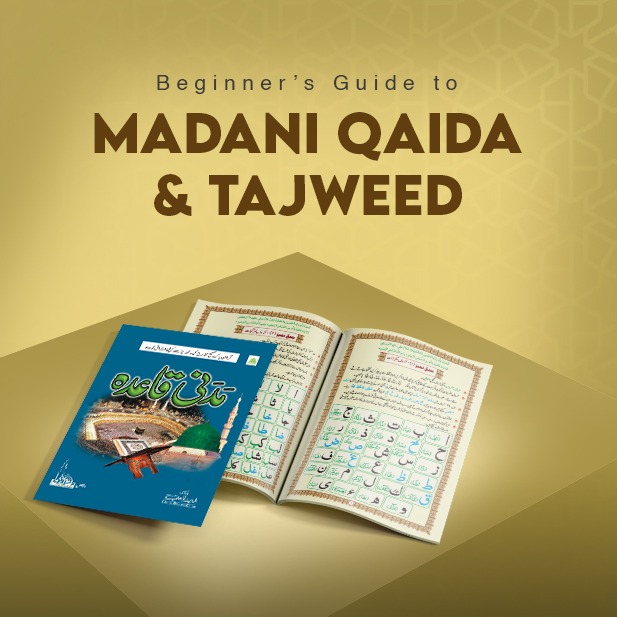
This guide will help beginners understand how to read Madani Qaida, learn its important rules, and get familiar with essential definitions used in basic Tajweed. With clear explanations and simple examples, this article will make your learning journey easier and more confident, whether you're learning yourself or teaching someone else.
1. What Is Madani Qaida?
Madani Qaida is a basic Arabic learning book designed for Quran beginners.
It helps you:
- Recognise Arabic letters
- Learn their sounds
- Join letters into words
- Read the Quranic text with correct Tajweed
- Understand essential rules like Madd, Harakaat, Sukoon, etc.
It is used in madrasas, online Quran classes, and by teachers worldwide.
Important Definitions for Beginners
. Important Definitions for Beginners
Here are the must-know Tajweed terms explained simply:
1. Harf (Letter)
Any Arabic alphabet letter.
2. Harakaat
Vowel marks (Zabar, Zer, Pesh).
3. Madd
Stretching a sound for a specific duration.
4. Sukoon (Jazm)
A letter with no vowel sound.
5. Shaddah
A sign indicating a strong/double sound.
6. Tanween
Double vowels (AN, IN, UN).
7. Qalqalah
A bouncing echo sound on certain letters:
ق ط ب ج د
8. Ikhfa
Nasal sound with “light hiding”.
9. Idgham
Merging two letters.
10. Izhaar
Clear pronunciation without a nasal sound.
4. Why Madani Qaida Is Important
- Builds a strong Tajweed foundation
- Helps avoid pronunciation mistakes
- Makes Quran reading smooth and beautiful
- Suitable for kids and adults
- Simple structure for easy learning
Important Question for learning the Quran
Question 1: How many Mufridat letters are there?
Answer: There are 29 Mufridat letters.
Question 2: How many Musta'liyah letters are there?
Answer: There are 7 Musta'liyah letters, and they are: خ ق غ ظ ط ض ص
Question 3: How are the Mustaʼliyah letters pronounced, and what is their combination?
Answer: Musta'liyah letters are always pronounced with a thicker voice in every condition, and their combination is خُصَّ ضَغْطٍ قِظٌ
Question 4: How many letters are there which are pronounced with the lips, and what are they?
Answer: There are 4 letters which are pronounced with the lips. They are: و, ب, م, ف
Question 5: How many Safeeriyah (whistle-sounding) letters are there, and what are they?
Answer: There are 3 Safeeriyah letters. They are: ز, س, ص
Question 6: What is meant by the term Harakaat?
Answer: Fathah [Zabar], Kasrah [Zayr] and Dammah [Paysh] are called Harakaat.
Question 7: How are Harakaat pronounced?
Answer: Harakaat are pronounced in an Arabic accent without stretching or suddenly pausing the voice.
Question 8: What is Tanween?
Answer: Fathatayn [Two Zabar], Kasratayn [Two Zayr] and Dammatayn [Two Paysh] are called ‘Tanween’. In fact, Tanween is a Noon Saakin, which is at the end of the word; this is why Tanween sounds like Noon Saakin.
Question 9: How many letters of Maddah are there? Mention them.
Answer: There are 3 letters of Maddah, and they are: الف, واو, یا
Question 10: How does an الف become Maddah?
Answer: When there is Fathah [Zabar] before an ألف, it becomes ألف Maddah. When there is a Dammah [Paysh] before a و Saakin, it becomes واو Maddah. When there is a Kasrah [Zayr] before a یا Saakin, it becomes یا Maddah.
Question 11: How are the letters of Maddah pronounced?
Answer: The letters of Maddah are pronounced by stretching them up to one ألف i.e. up to two Harakaat.
Question 12: What is meant by vertical [Khari] Harakaat?
Answer: Vertical Fathah [Zabar], vertical [Zayr] and inverted Dammah [Paysh] are called vertical [Khari] Harakaat.
Question 13: How are the vertical Harakaat pronounced?
Answer: Vertical Harakaat are pronounced by stretching them up to one ألف, i.e. up to two Harakaat, like that in the case of the letters of Maddah.
Question 14: How many letters of Leen are there? Mention them.
Answer: There are two letters of Leen: وَآو and یا
Question 15: How are the letters of Leen pronounced?
Answer: The letters of Leen are pronounced gently in an Arabic accent without any stretching or sudden pausing.
Question 16: How will a واو and a یا become a واو Leen and a یا Leen, respectively?
Answer: When there is a Fathah [Zabar] before a واو Saakinah, it becomes a واو Leen.
When there is a Fathah [Zabar] before a يا Saakinah, it becomes a یا Leen.
Question 17: What is the meaning of Qalqalah?
Answer: The meaning of Qalqalah is movement; there should be some movement at the Makharij (places where the letters are pronounced) such that the sound echoes.
Question 18: How many letters of Qalqalah are there? What are they, and what is their combined form?
Answer: There are five letters of Qalqalah, د, ج, ب, ط, ق, and their combined form is قُطْبُ جَدّ
Question 19: When will Qalqalah be made more clear in the letters of Qalqalah?
Answer: When the letters of Qalqalah are Saakinah, Qalqalah should be more clear.
Question 20: How are the letters of Qalqalah pronounced when Mushaddadah?
Answer: When the letters of Qalqalah are Mushaddadah, they are pronounced with emphasis.
Conclusion
Madani Qaida is the key to reading the Holy Quran with correct pronunciation.
By learning letters, vowels, joining rules and essential Tajweed concepts, anyone can become confident in Quranic reading. With steady practice and guidance, this journey becomes easy, beautiful and spiritually uplifting.